





Eye For Film >> Movies >> To Hold A Mountain (2026) Film Review

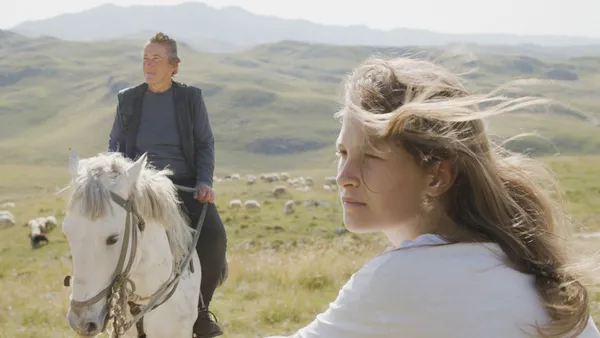

Biljana Tutorov and Petar Glomazić’s To Hold A Mountain observes an anachronic coexistence on Montenegro’s Sinjajevina plateau. Gara and her 13-year-old daughter Nada return each year to ancestral pastures at 2,000 meters, herding animals and living in symbiosis with a landscape they call “Mother,” even as the Montenegrin government advances plans for a NATO-backed military training ground in the heart of this protected terrain. If Heidi (Johanna Spyri’s Swiss pastoral of alpine innocence) is the fantasy of mountain life, Hasanaginica is its counter-legend, where honour codes turn domestic life into exile and sever motherhood. This documentary lives in the space between them.
It never pretends the threat is abstract. Helicopters descend, meetings are held, tensions flare, and the prospect of militarisation carries its own violence, even when it arrives framed as national defense. Yet Tutorov and Glomazić resist the obvious shape of a single-issue polemic. The proposed training ground becomes a pressure system in the background, while the foreground stays intimate and domestic, built from routine, fatigue, competence, and the stubborn dignity of people who know exactly what it costs to keep a life going.
If documentaries rarely have plot twists, this one does, and it lands like a stone to the chest. The film lets you settle into the texture of pastoral time, then reminds you that “untouched” landscapes do not guarantee untouched lives. Its most devastating revelations are not delivered for shock, but to clarify what endurance has been asked to absorb, and what an apparently quiet life has been trained to survive.
Gara recalls her parents’ “separation,” though divorce is too clean for what she describes: a husband who could “return” a wife to her brothers, and extract a confession with a knife at her throat. The resonance is Hasanaginica – the South Slavic ballad where a woman is cast out and separated from her children under patriarchal codes of honour. To Hold A Mountain lets Gara sit with the question that follows: what fear outweighs the fear of losing your children?
The women of Sinjajevina, many of them older, speak with the steadiness of people who have lived without the contemporary vocabulary of trauma, but not without its reality. Wrinkles read less like decay than record. Their hair greys, and it made me think of a regional saying, "evo cvijeta s onoga svijeta," a blossom from the world beyond. Dye is mixed the way coffee is poured, as upkeep rather than confession, as if mortality were simply another chore folded into the day.
For a country in a neighborhood forever bullied into proving whether it belongs to East or West, and repeatedly claimed by both when convenient, any outside incursion activates something older than ideology. You can call it history, but it lands closer to embodied memory, the body’s knowing, the reflexive suspicion that arrives before argument.
Visually, the film earns its title. One shot crops a cow so tightly that only the ridgeline of its back is visible, withers and spine rising like a low mountain chain. Then she inhales, and the “mountains” move. A small, perfect revelation in a world where “Mother” is not metaphor but orientation.
Glomazić’s prior life in civil aviation, more than two decades inside that bird’s-eye logic, may help explain the directors’ comfort with scale, altitude, and the feeling of human fragility against terrain. But the achievement here is not just aerial. Filmed over seven seasons, the co-directors make time tactile. Weather, repetition, aging, and the slow accumulation of strain until it finally shows itself.
To Hold A Mountain is an ode to Montenegro's Sinjajevina, but it also widens into a lament and a salute to the Western Balkans, to people who not long ago were compatriots, and to rural lives that keep carrying tradition not as nostalgia, but as labour, inheritance and survival.
Reviewed on: 27 Jan 2026